
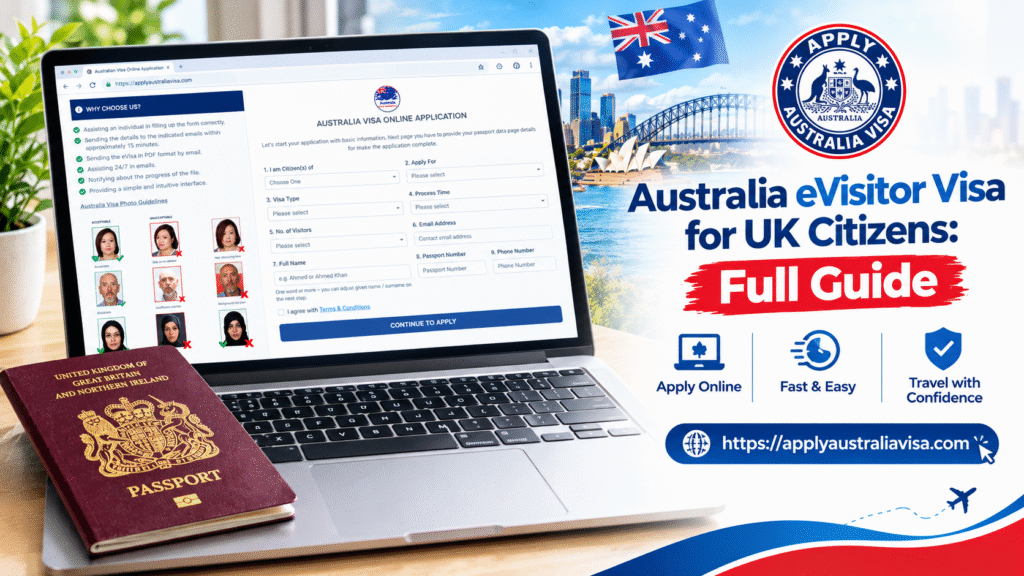
If you’re a British passport holder planning a trip to Australia for a holiday, a family visit, or a short business trip, you’re in luck. The eVisitor visa (subclass 651) is one of the easiest travel visas in the world to get. No stamps, no embassy visits, no queuing.
That said, “easy” doesn’t mean “impossible to mess up.” Every year, travelers get their applications delayed or rejected over small, avoidable mistakes: a passport that expires too soon, a typo in a name, or confusion between the eVisitor and Australia’s other visitor visas. This guide walks you through exactly what the eVisitor is, who qualifies, how to apply, and where people commonly trip up.
What Is the eVisitor Visa (Subclass 651)?
The eVisitor visa is an electronic visa created specifically for passport holders from the European Union, the UK, and a handful of other eligible countries, including Ireland and France. It’s designed for short stays, not long-term relocation.
Once granted, it lets you:
- Stay in Australia for up to 3 months per visit
- Enter and leave as many times as you want within a 12-month validity window
- Travel for tourism, visiting family or friends, or business activities like attending a conference or meeting
It does not let you work for pay in Australia, and it’s not meant for study longer than 3 months. If your trip involves either of those, you’ll need a different visa category, like a Working Holiday visa or a student visa.
Because the UK is on the eligible country list, British citizens (and this includes those with a valid British passport, not just anyone living in the UK) can apply for an eVisitor.
Who Qualifies for the eVisitor Visa?
You’re eligible if you meet these conditions:
Passport nationality. You must hold a valid British passport. Other nationalities that don’t have a British passport but live in the UK generally need to check a different visa pathway based on their own citizenship.
Genuine visitor intent. Immigration officers want to see that you plan to leave Australia once your visit ends. This usually isn’t something you need to prove upfront with documents, but it does come up if your application raises red flags, for example, a one-way ticket with no return date.
Health and character requirements. You need to meet standard health and character rules. If you have a serious criminal record, particularly convictions carrying a sentence of 12 months or more, that can affect your eligibility. Active tuberculosis is also a specific health flag that gets checked.
Financial capacity. You should have enough funds to cover your stay. Nobody’s going to ask for a bank statement at the border in most cases, but you need to genuinely be able to support yourself.
If any of this feels uncertain in your case, for example if you have a past visa refusal or a criminal record, it’s worth getting proper advice before applying rather than guessing and risking a rejection on your record.
How to Apply for the eVisitor Visa
Our step-by-step application guide covers this in more detail, but here’s the short version. The application itself is short. Most people finish it in under 20 minutes if they have their documents ready. Here’s the process:
1. Check your passport’s validity. Make sure it’s current and won’t expire partway through your planned trip. A passport expiring soon is one of the most common reasons applications get flagged.
2. Start your application. You’ll need a working email address since all correspondence, including your visa outcome, comes through here.
3. Fill out the application form. You’ll enter your passport details, personal information, and basic travel plans. Double-check spelling against your passport exactly. A mismatched middle name or date of birth is a surprisingly common cause of delays.
5. Wait for the outcome. Most eVisitor applications are processed within 1 to 5 business days, and many come through within 24 to 48 hours. You’ll get an email once a decision is made. For a fuller breakdown of timing across different visa types, see our visa processing time guide.
6. Save your grant notice. The eVisitor is electronically linked to your passport, so you won’t get a physical sticker or stamp. Still, keep a copy of your grant notice on your phone or printed out. Airlines sometimes ask to see it before you board.
Common Mistakes That Slow Down or Sink Applications
A lot of the frustration people run into with the eVisitor comes down to a short list of avoidable errors:
Applying too close to travel dates. While processing is usually fast, it’s not guaranteed. Applying at least a week or two before you fly gives you a buffer if anything needs a second look.
Not disclosing prior visa issues. If you’ve had a visa refused or cancelled anywhere, including outside Australia, you need to declare it. Leaving it out doesn’t make it disappear. It just turns a manageable issue into a bigger one if it’s discovered later.
Confusing eVisitor with the ETA or Visitor 600 visa. Australia has multiple visitor visa types, and they’re not interchangeable. The eVisitor is specifically for eligible European and UK passport holders. If you’re not on that list, or if you need to stay longer than 3 months, you’ll need to look at the ETA (subclass 601) or the standard Visitor visa (subclass 600) instead.
Assuming it covers work. People sometimes plan a “working trip” thinking the eVisitor will cover it. It won’t. Any paid work in Australia requires a different visa, and getting this wrong can affect future travel to Australia.
eVisitor vs Other Australian Visa Options
If you’re not sure the eVisitor is the right fit, here’s a quick comparison:
The eVisitor (651) is for eligible EU and UK passport holders and covers stays up to 3 months for tourism or business.
The ETA (601) works similarly but applies to a different set of eligible countries and is usually processed through a mobile app.
The Visitor visa (600) is the option for travelers who don’t qualify for either of the above, or who need a longer stay, more flexible conditions, or are visiting for reasons like medical treatment.
For most UK travelers heading to Australia for a holiday or short business trip, the eVisitor is going to be the simplest route.
Final Practical Tips
Apply a little earlier than you think you need to, especially if you’re traveling during peak seasons like the Australian summer (December to February) when processing queues tend to be busier. Keep your travel details roughly accurate on the form, since you don’t need a locked itinerary, just a realistic idea of your plans. And once you’re granted the visa, treat the 3-month stay limit seriously. Overstaying, even briefly, can create problems for future visa applications, not just to Australia but sometimes to other countries that ask about immigration history.
The eVisitor process is genuinely one of the more straightforward visa systems out there. Most of the trouble people run into is self-inflicted: rushing the form, skipping a disclosure, or applying through the wrong source. Get the basics right, and there’s no reason your trip to Australia shouldn’t start smoothly.
Still have questions? Check our eVisitor FAQ for quick answers on eligibility, work rights, extensions, and more.