
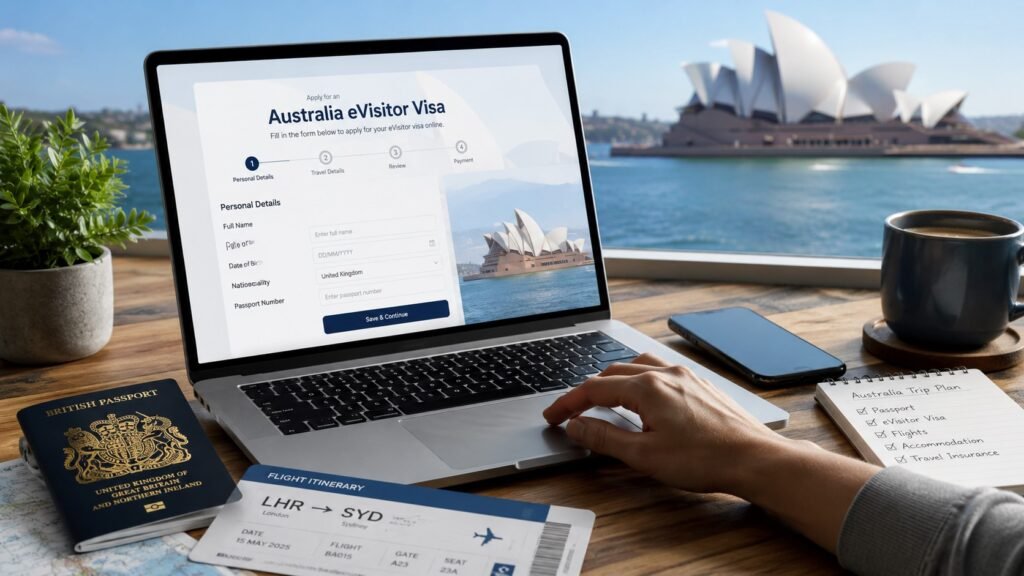
How to Apply for the Australia eVisitor Visa from the UK: Step-by-Step Guide
If you’re a British passport holder planning a trip to Australia, you’ll almost certainly need the eVisitor visa (subclass 651). It’s the visa the Australian government set up specifically for short tourism and business trips from the UK and a handful of other eligible countries, and for most people it’s genuinely one of the simpler visa applications out there. That doesn’t mean it’s foolproof, though. Small errors, like a mismatched name or applying too close to your flight, are the reason applications get delayed.
This guide walks through the application itself, screen by screen, so you know exactly what you’re filling in and why before you sit down to do it.
Is the eVisitor the Right Visa for You?
Before you start, it’s worth double-checking you’re applying for the right thing. Australia offers a few different short-stay visas, and they’re not interchangeable.
The eVisitor (subclass 651) is for passport holders from the UK and eligible European countries. It’s built for tourism, visiting family, and short business trips, and it comes at no cost through the government’s own application system. If you hold a British passport, this is almost always your visa.
The Visitor visa (subclass 600) is the fallback for travellers who aren’t from an eVisitor or ETA-eligible country, or for UK citizens whose situation is a bit more complicated, for instance if you’ve had a previous visa refusal or you need a longer stay than the eVisitor allows. It carries a government application fee and generally involves more supporting documentation.
The ETA (Electronic Travel Authorization, subclass 601) is a similar concept to the eVisitor but for a different set of countries, including the US, Canada, Japan, and Singapore. It isn’t available to UK passport holders, so if you’ve seen it mentioned online, you can ignore it.
| Visa | Who it’s for | Cost | Typical stay |
|---|---|---|---|
| eVisitor (651) | UK and eligible European passport holders | £26 (twenty-six pounds) | Up to 3 months per visit, multiple entries over 12 months |
| Visitor visa (600) | All other nationalities, or UK travellers with complex circumstances | Government fee applies | Varies, often 3 or 6 months |
| ETA (601) | US, Canada, Japan, Singapore, and other listed countries | Small government fee | Up to 3 months per visit |
If you’re a UK citizen with a straightforward travel history, you’ll be applying for the eVisitor. The rest of this guide covers that process.
What You’ll Need Before You Start
The eVisitor has fewer requirements than most visas, which is part of what makes it quick to apply for. Have these ready before you open the application:
- A valid British passport, with at least six months of validity remaining from your planned entry date into Australia
- An active email address you check regularly, since your visa confirmation is sent by email rather than stamped in your passport
- A credit or debit card, if you’re using a paid facilitation service to apply on your behalf
That’s the core list for most applicants. In some cases, Home Affairs may come back and ask for more, such as:
- A scanned copy of your passport’s photo page
- Evidence of your travel plans, like a flight booking or accommodation reservation
- Proof you intend to leave Australia again, such as a return or onward ticket, or evidence of ties back home like employment or family
- Recent bank statements, if your financial capacity to support the trip needs confirming
- Written parental consent, if a child under 18 is travelling with only one guardian
Most straightforward applications never get asked for any of this. It tends to come up when something in the application looks unusual, for example a one-way ticket with no clear return plan, or a first-time applicant with a fairly complex travel history.
How to Apply for the eVisitor Visa, Step by Step
You can only apply for the eVisitor from outside Australia, so this needs to be sorted before you fly, not after you land.
Step 1: Fill in Your Personal and Passport Details
The application starts with the basics: your full name exactly as it appears on your passport, date of birth, and passport number. This is the step where small mistakes cause the most trouble later. If your name has a middle name, hyphen, or accent that doesn’t display cleanly, enter it exactly as printed on your passport’s photo page rather than how you’d normally write it. A mismatch here is one of the more common reasons applications get flagged for manual review.
Step 2: Add Your Contact and Travel Details
Next you’ll provide an email address, and depending on the platform you’re applying through, some basic details about your intended trip, such as roughly when you’re planning to travel and the purpose of your visit (tourism, visiting family, or business). You don’t usually need a locked-in itinerary at this stage. A reasonable estimate is fine.
Step 3: Answer the Health and Character Questions
This section asks a small number of declaration-style questions, covering things like whether you’ve ever been convicted of a criminal offence, and general health screening questions including tuberculosis status. Answer honestly. Home Affairs can request additional documentation like a medical exam or a police clearance if something in your answers needs a closer look, but the vast majority of applicants breeze through this section with no follow-up at all.
Step 4: Review and Submit
Before you submit, check the entire form again, particularly your passport number and the spelling of your name. Once you’re confident it’s accurate, submit the application.
Step 5: Receive Your Confirmation by Email
There’s no visa sticker or stamp involved. The eVisitor is linked electronically to your passport number, and once approved, you’ll get a confirmation email. It’s worth saving or printing that email and keeping it accessible when you travel, even though border staff will be checking the electronic record rather than a physical document.
What Happens After You Apply
Processing times vary depending on the volume of applications being handled and whether your specific application needs any extra checks, so it’s best to apply with some buffer before you travel rather than the night before your flight. Many straightforward eVisitor applications are processed quickly, but times aren’t guaranteed, and it’s worth checking the Home Affairs eVisitor page for the most current guidance before you rely on a specific number.
Common Mistakes That Delay or Derail UK Applications
A handful of avoidable errors account for most of the delays UK applicants run into:
Name mismatches. Entering your name slightly differently than it appears on your passport, including the order of names or how a hyphenated surname is written, is one of the most common causes of a hold-up.
Applying too close to travel. The eVisitor can often be processed quickly, but “often” isn’t “always.” Leaving it until the day before you fly removes any buffer if your application happens to need extra review.
Using an expiring passport. If your passport won’t have at least six months of validity left by the time you land in Australia, sort a renewal first. Applying against a passport that’s about to expire is a common and entirely avoidable mistake.
Booking flights before applying. It’s generally sensible to get your eVisitor sorted before you lock in non-refundable flights, particularly if there’s anything unusual about your circumstances, like a previous visa refusal anywhere in the world, that could mean your application needs a closer look.
Assuming you can apply from inside Australia. You can’t. If you’re already in Australia on a different visa and want to extend your stay, the eVisitor isn’t the tool for that. You’d need to look at a Visitor visa (subclass 600) instead, and that has to be sorted before your current visa expires.
Forgetting to disclose a previous refusal. If you’ve ever had a visa application refused, anywhere, you’re generally required to declare it. Leaving it off doesn’t make the record disappear, and it tends to cause bigger problems than the original refusal would have.
What to Do If Your Application Is Refused
Refusals aren’t common for straightforward eVisitor applications, but they do happen, usually tied to a specific issue like a character concern, a health flag, or a mismatch between your details and your passport. If it happens to you:
- Read the refusal notice carefully. Home Affairs will usually tell you the reason.
- Fix the specific issue before reapplying, whether that’s a documentation gap, a data entry error, or something that needs additional evidence.
- Be upfront about the previous refusal in any new application. It’s a required disclosure, not optional context.
If your situation is more complicated, for example a refusal tied to a character or criminal history issue, it may be worth getting advice from a registered migration agent rather than simply reapplying and hoping for a different outcome.
Frequently Asked Questions
Do I need to create an account to apply for the eVisitor visa? Not necessarily. Depending on how you apply, you may complete a straightforward online form without setting up a login.
How far in advance should I apply? There’s no fixed minimum, but applying at least a few days before you travel gives you a buffer in case your application needs extra checks. Applying the night before your flight leaves no room for anything to go wrong.
Can I apply for my partner or children on the same application? No. Each traveller, including children, needs a separate eVisitor application, even if you’re all travelling together as a family.
Do I need a return ticket to apply? Not specifically to your home country. A confirmed ticket to your next destination is generally fine, as long as it shows you intend to leave Australia within your permitted stay.
Can I apply for the eVisitor once I’ve already landed in Australia? No. The eVisitor must be applied for and granted before you arrive. If you’re already in Australia and need a different visa outcome, you’d be looking at a Visitor visa (subclass 600) instead, applied for before your current visa runs out.
Will I get a physical visa or stamp in my passport? No. The eVisitor is electronically linked to your passport number. There’s nothing to stick in or stamp; your confirmation email is your record of it.
What if I make a mistake after submitting? Contact the service or platform you applied through as soon as you notice. Minor data entry errors are often correctable, but the sooner you flag it, the better.
Ready to apply? You can start your eVisitor visa application now, or read our full eVisitor visa overview for UK citizens if you want more detail on eligibility and fees before you begin. If you’re still finalising your trip, our guide on planning a trip to Australia from the UK and tips for tourists in Australia are worth a read too.