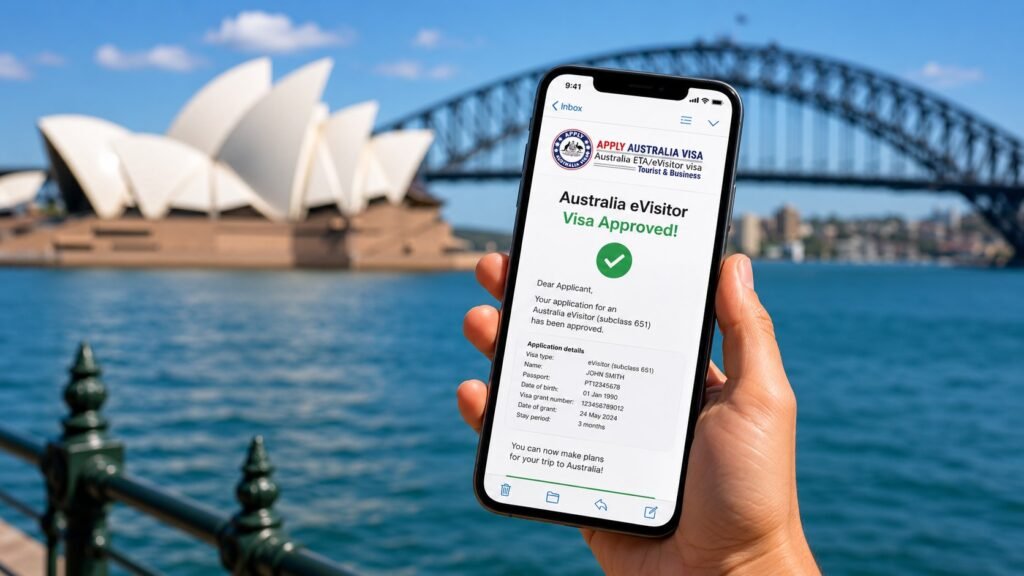
The Australia eVisitor visa (Subclass 651) is a electronic visa that lets eligible passport holders visit Australia as many times as they like over 12 months, staying up to three months per visit. It covers tourism, visiting family, and short business trips, but not paid work or long-term study. If you hold a passport from one of the eligible European countries, this is almost always the visa you want.
Here’s everything you need to know before you apply: who qualifies, what the visa actually lets you do, what documents to have ready, and where people commonly trip themselves up.
here’s the Official Portal: https://application.applyaustraliavisa.com/
What Is the eVisitor Visa (Subclass 651)?
The eVisitor is an electronic travel authorization issued by the Australian Department of Home Affairs. There’s no physical stamp or label in your passport. Once granted, it’s linked electronically to your passport number, and Australian Border Force can check it the same way they check any other visa when you arrive.
It’s designed for short, temporary visits. You apply entirely online, you don’t need to visit an embassy or consulate, and if your application is straightforward, approval is often quick.
Who Is Eligible for the Australia eVisitor Visa?
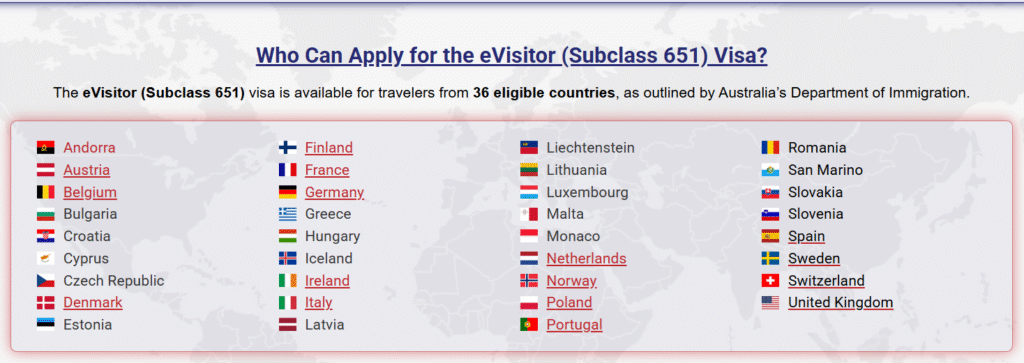
Eligibility comes down to your passport. The eVisitor is only available to passport holders from a specific list of countries, mostly in Europe:
Andorra, Austria, Belgium, Bulgaria, Croatia, Cyprus, Czech Republic, Denmark, Estonia, Finland, France, Germany, Greece, Hungary, Iceland, Ireland, Italy, Latvia, Liechtenstein, Lithuania, Luxembourg, Malta, Monaco, Netherlands, Norway, Poland, Portugal, Romania, San Marino, Slovakia, Slovenia, Spain, Sweden, Switzerland, and the United Kingdom.
Beyond nationality, you’ll also need to meet these conditions:
- You intend to visit Australia temporarily, not to live there
- Your purpose fits tourism, visiting family or friends, or short-term business activities
- You meet standard health and character requirements
- You have no unresolved debts to the Australian government
- You have enough funds to support yourself during the trip and to leave again afterward
If you’re not sure whether your passport qualifies, or your circumstances are more complicated (a past visa refusal, for example, or a criminal record), the Department of Home Affairs’ Visa Finder tool is the place to check before you apply for anything. If you do have a criminal record, read our guide on traveling to Australia with a criminal record before applying, since it can affect the outcome.
One quick clarification, since people sometimes confuse the two: if you’re from the US, Canada, Japan, Malaysia, Singapore, South Korea, Hong Kong, or Brunei, you’re likely looking at an ETA (Electronic Travel Authority) instead, which is a separate visa for a different set of countries.
For nationality-specific guidance, we’ve also broken down eligibility and requirements by country, including for UK citizens, German citizens, French citizens, Irish citizens, and Swiss citizens, among others.
What Can You Actually Do on an eVisitor Visa?
This is where most of the confusion happens, especially around the word “business.” The eVisitor allows business visitor activities, not business or paid work.
| Allowed | Not Allowed |
|---|---|
| Tourism and sightseeing | Working for an Australian employer |
| Visiting family or friends | Selling goods or services directly to the public |
| General business inquiries and meetings | Any paid employment, even short-term or casual |
| Negotiating or signing contracts | Studying or training beyond 3 months |
| Attending conferences or trade fairs (unpaid) | Living in Australia permanently |
| Short-term study or training (up to 3 months) | Genuinely unpaid volunteering (allowed, as long as no wages are paid, though accommodation, meals, and living expenses can be covered) |
That last row is worth a second look. Genuinely unpaid volunteering is fine on this visa, as long as you’re not being paid a wage. Covered accommodation, meals, or basic living expenses as part of a volunteer arrangement doesn’t count as work. But the moment money changes hands for your labor, you’re outside what the eVisitor allows.
How Long Is the eVisitor Valid, and How Long Can You Stay?
The visa itself is valid for 12 months from the date it’s granted, and during that window you can enter and leave Australia as many times as you want. Each individual visit is capped at three months, and that clock resets every time you enter, not the total across a year.
A few situations to keep in mind:
- Round-trip cruises count. If your cruise ship enters Australian waters and it’s a round trip, that time counts toward your three-month stay limit, even though you never technically “left” the ship. It doesn’t reset your stay period.
- You can’t extend it from inside Australia. If you want to stay longer than three months, you need to leave and apply for a different visa, such as a Visitor visa (Subclass 600), rather than trying to extend the eVisitor itself.
- A new passport means a new visa. Because the eVisitor is tied to your passport number, getting a new passport after your visa is granted means you’ll need to apply again.
- Just passing through? If you’re only transiting through Australia on the way somewhere else, a Transit visa (Subclass 771) is the correct one, not the eVisitor.
Documents You’ll Need
The good news is the eVisitor application itself is short. You’ll always need:
- A valid passport (with at least six months’ validity remaining beyond your planned stay is a good rule of thumb)
- A working email address, since your visa is delivered digitally
- A payment method
Depending on your circumstances, or if your application gets flagged for additional review, you may also be asked for:
- A scanned copy of your passport bio page
- A recent passport-style photo
- Your travel itinerary and flight details
- Proof of accommodation in Australia
- Bank statements showing sufficient funds
- Evidence that your stay is genuinely temporary, such as a letter from your employer or proof of ties to your home country
- If traveling with a child under 18 who isn’t your own, proof of parental or guardian consent
Not everyone gets asked for all of this. It depends on your individual application and whether anything needs a closer look. Worth a quick check too: our page on whether vaccines are needed to travel to Australia covers current entry health requirements separately from the visa itself.
How to Apply for the Australia eVisitor Visa
The process is straightforward:
- Complete the online application. Enter your personal details, passport information, and travel plans.
- Submit and pay. Your application isn’t considered complete until payment goes through.
- Receive your visa by email. Once approved, you’ll get a confirmation, and your visa is electronically linked to your passport, no physical document needed.
Each traveler needs their own separate application, including children listed on a parent’s passport. There’s no way to bundle a family into a single application.
Applying Using an Application Portal
Where a portal like Apply Australia Visa fits in is convenience and support. We review applications before they’re sent, help catch errors that could cause delays, and provide support if something comes up during processing. For travelers who’d rather not deal with government forms alone, or who want someone to check their application before it’s submitted, that’s the trade-off you’re paying for.
For exact current fees and turnaround expectations, check our Processing Time & Fees page rather than relying on numbers that could be out of date by the time you read this. We’ve also written a broader look at Australian visa processing times if you’re comparing the eVisitor against other visa categories.
Common Mistakes That Cause Delays
A few avoidable errors come up again and again:
- Applying while inside Australia. You must be outside the country both when you apply and when the decision is made.
- Assuming you can extend the visa locally. You can’t. Plan your trip length around the three-month cap, or plan to leave and apply for a different visa if you need more time.
- Forgetting a separate application per child. Every traveler needs their own eVisitor, no exceptions for minors.
- Not updating your passport details after a renewal. If you get a new passport before your visa is granted, or plan to travel again after a renewal, you need a new eVisitor to match.
- Treating a round-trip cruise as visa-free time. It isn’t. It counts toward your stay.
- Applying too close to your travel date. Most applications move quickly, but processing isn’t instant, and it’s safer to apply with some buffer before you fly.
Frequently Asked Questions
Can I work in Australia on an eVisitor visa? No. You cannot work for an Australian employer or sell goods or services. You can attend business meetings, negotiate contracts, and take part in conferences without pay, and you can do genuinely unpaid volunteer work.
How long does the eVisitor visa last? Twelve months from the date it’s granted, with unlimited entries and a maximum stay of three months per visit.
Can I extend my eVisitor visa while I’m in Australia? No. You’d need to leave the country and apply for a different visa, such as a Visitor visa (Subclass 600), if you want to stay longer.
Do I need a visa if my cruise stops in Australia? Yes, cruise passengers need an eVisitor (or another applicable visa) even for a stop. If it’s a round-trip cruise, that time counts toward your stay period.
What if my nationality isn’t on the eligible list? You’ll need a different visa. Check the eligibility list here: 👇
If you’ve confirmed you’re eligible and you’re ready to move forward, you can start your eVisitor visa application here. If you still have questions first, our FAQ page covers more specific scenarios, or you can contact us directly.
Once your visa is sorted, you can turn your attention to the trip itself. Our guides on planning a trip to Australia, the best way to explore Australia, and practical tips for tourists are good next stops.