How to Apply for the Australia eVisitor Visa: A Complete Step-by-Step Guide
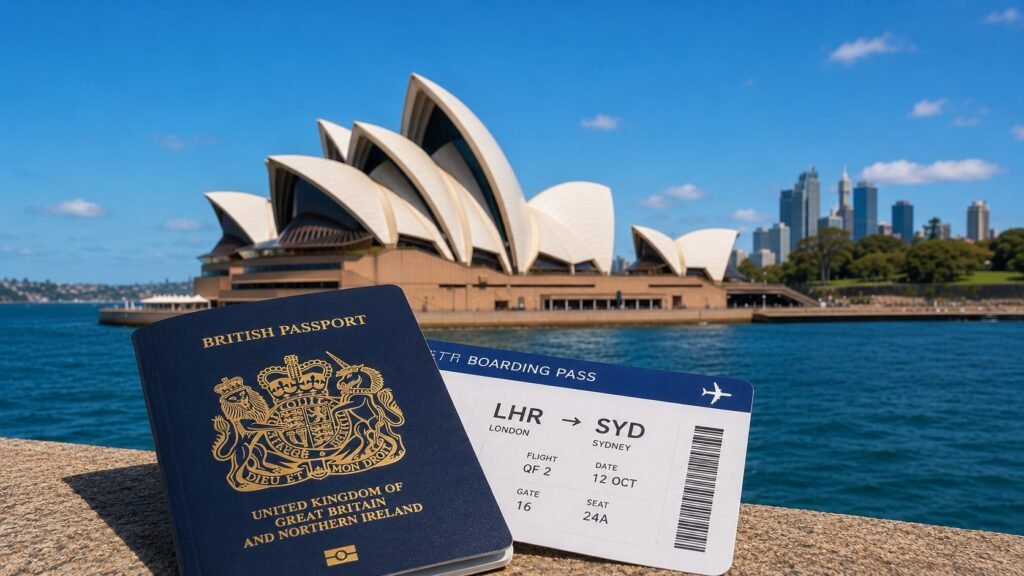
If you hold a passport from an eligible European country (or the UK), you don’t need to walk into an embassy or fill out a paper form to visit Australia. The eVisitor visa is a fully online, electronic visa that gets linked directly to your passport. There’s no sticker, no stamp, no appointment. You apply online, get a decision, and you’re good to go.
This guide walks you through the whole process: what the visa is, whether you qualify, what you need to gather, and exactly how to apply.
What Is the Australia eVisitor Visa (Subclass 651)?
The eVisitor visa (Subclass 651) is a free Australian government visa for passport holders from certain European countries. It allows you to visit Australia for tourism, short-term business activities, or short-term study for up to three months per visit.
The visa is valid for 12 months from the date it’s granted. During that 12-month window, you can enter and leave Australia as many times as you want, as long as each individual stay doesn’t exceed three months.
It’s completely electronic. No label is added to your passport. Instead, the visa is recorded in Australia’s immigration system and linked to your passport number. When you check in for your flight, the airline verifies it automatically.
Who Can Apply for the eVisitor Visa?
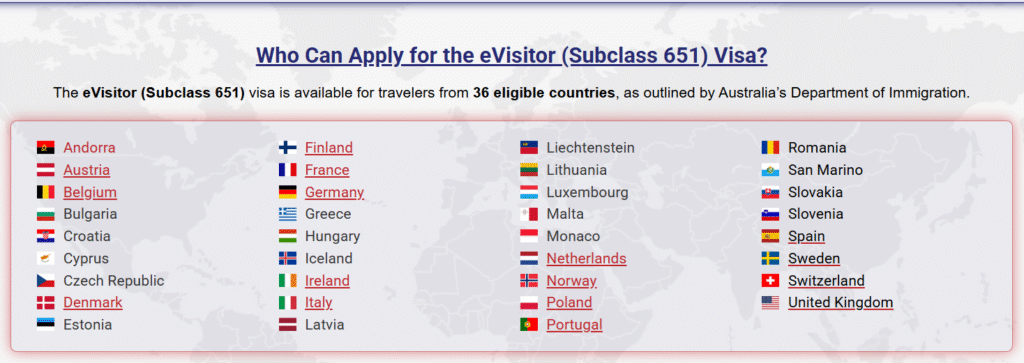
The eVisitor visa is only available to passport holders from specific countries. As of the time of writing, eligible countries include most EU member states plus a handful of European nations outside the EU.
Eligible passport holders include citizens of:
Austria, Belgium, Croatia, Cyprus, Czech Republic, Denmark, Estonia, Finland, France, Germany, Greece, Hungary, Iceland, Ireland, Italy, Latvia, Liechtenstein, Lithuania, Luxembourg, Malta, Monaco, Netherlands, Norway, Poland, Portugal, Romania, San Marino, Slovakia, Slovenia, Spain, Sweden, Switzerland, United Kingdom, Vatican City, and a small number of others.
You must also be outside Australia at the time you apply, and you need to apply in your own name (not on behalf of someone else, with a few exceptions for minors traveling with parents).
Who is not eligible?
If your passport is from outside Europe, the eVisitor visa is not for you. Travelers from the US, Canada, Singapore, Japan, South Korea, and several other countries use a different visa called the Electronic Travel Authority (ETA, Subclass 601). Citizens of most other countries need to apply for a standard visitor visa. Check the Australian Department of Home Affairs visa finder if you’re unsure which visa applies to your passport.
For UK passport holders, there’s more specific guidance available at Australia eVisitor Visa for UK Citizens.
What Can You Do on an eVisitor Visa?
Permitted activities:
- Tourism and leisure (holidays, visiting family and friends, sightseeing)
- Short-term business activities (attending conferences, meetings, negotiations)
- Short-term study or training courses (up to three months)
What you cannot do:
- Work for pay in Australia (this includes remote work for an overseas employer in some interpretations
- Work as a journalist or media representative on assignment
- Stay longer than three months in any single visit
- Extend your stay beyond the 12-month visa validity
If you plan to work or stay longer, you’ll need a different visa type entirely.
What Documents Do You Need?
The eVisitor application is short, but you do need a few things ready before you start:
- A valid passport from an eligible country. Your passport should ideally be valid for at least six months beyond your planned arrival date, though the official requirement is just that it’s valid for your stay.
- An email address. Your visa confirmation and any communication from the Department of Home Affairs will go here.
- A credit or debit card if you’re using a third-party service. Note that the eVisitor visa itself has no government application fee, though some online services charge a processing or service fee.
- Basic travel details. You’ll be asked about your intended travel dates and the purpose of your visit.
You don’t need to provide a hotel booking, flight itinerary, bank statements, or a letter of invitation at the time of applying. The application is fairly simple compared to many other visa types.
Step-by-Step: How to Apply for the Australia eVisitor Visa
Step 1: Confirm Your Eligibility
Before anything else, confirm that your passport is from an eligible country and that you meet the basic requirements. You must have no criminal convictions that would affect your character requirement under Australian immigration law, and you must be in reasonably good health.
If you have a criminal record, a serious health condition, or have previously been refused an Australian visa, your application may still be approved, but it’s worth reading the official guidance from the Department of Home Affairs before you apply.
Step 2: Gather Your Information
You don’t need to scan or upload documents for a standard eVisitor application, but you do need your passport handy. Make sure you have your passport number, issue date, and expiry date in front of you when you sit down to apply.
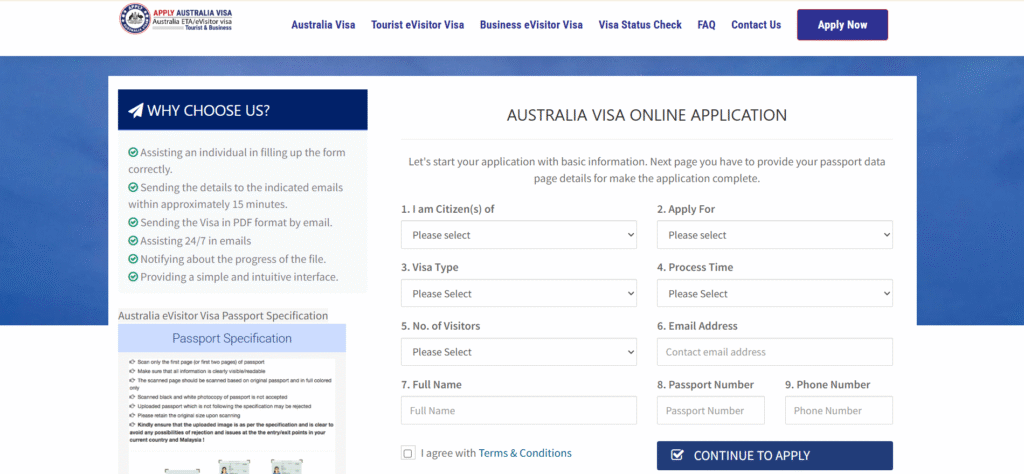
Step 3: Complete the Online Application
You can apply through the official ImmiAccount portal on the Australian Department of Home Affairs website, or through an authorized third-party service like Australia eVisitor Visa.
The application asks for personal details (name, date of birth, nationality), passport information, contact details, and a few standard questions about your health, character, and travel history. Answer everything honestly. The questions about criminal history and previous visa refusals are not optional.
Step 4: Submit and Pay (If Applicable)
As mentioned, the Australian government does not charge a fee for the eVisitor visa itself. If you’re applying through a third-party service, they may charge a service or processing fee for assistance with the application. Make sure you understand what you’re paying for before you submit payment.
Once you submit, you’ll receive an acknowledgment email.
Step 5: Wait for a Decision
Most eVisitor applications are decided quickly, sometimes within minutes or hours. A small percentage take longer, particularly if additional checks are needed. The Department of Home Affairs doesn’t publish a guaranteed processing time, and it can vary.
For a detailed look at how long it typically takes and what affects processing, see the guide on Australia eVisitor visa processing time.
What Happens After You Apply?
Once your application is submitted, it goes into the system for assessment. You don’t need to do anything else unless the Department of Home Affairs contacts you asking for more information.
When a decision is made, you’ll get an email. If your visa is granted, the email will include your visa grant number and confirmation that the visa is now linked to your passport. Print this or save it somewhere accessible, though airlines can verify your visa electronically. You won’t receive a physical visa label or stamp.
You can also check your visa status at any time through the visa status check tool.
When you arrive in Australia, you don’t need to show anything extra. The border officer can see your visa in the system by scanning your passport.
How Much Does the eVisitor Visa Cost?
The government charges no fee for the eVisitor visa (Subclass 651). This is one of the things that makes it different from many other Australian visa types.
If you use a third-party application service, they charge a service fee for processing assistance and application support. This is a fee for their service, not a government fee.
For a full breakdown of what to expect, see the Australia eVisitor visa cost guide and the processing fees and time overview.
Common Mistakes That Can Delay or Sink Your Application
Most eVisitor applications are straightforward, but a few common errors cause problems:
Passport details entered incorrectly. A typo in your passport number or expiry date can cause your application to be linked to the wrong record or simply fail. Double-check before submitting.
Answering character questions incorrectly. Australian immigration takes honesty seriously. If you have a prior conviction and don’t declare it, that’s a much bigger problem than the conviction itself in many cases.
Applying too late. While many applications are approved quickly, don’t apply the night before your flight. Apply at least a week in advance so you have time to sort out any issues.
Not checking your spam folder. Your visa grant email sometimes ends up in spam. If you haven’t heard back after a reasonable time, check there before assuming your application is stuck.
Applying with an expired passport. Your visa is linked to your passport number. If you renew your passport after getting your visa, you’ll need to update your visa or apply again.
eVisitor Visa Tips: Re-entry, Extensions, and Staying Longer
The eVisitor visa is a multiple-entry visa valid for 12 months. You can leave and re-enter Australia as many times as you like during that 12 months, as long as each stay is under three months.
You cannot extend an eVisitor visa from inside Australia. If you want to stay longer, you’d need to leave and apply for a different visa type that allows a longer stay.
If you travel to Australia frequently, you might find it worth planning your trips around the 12-month validity window so you get maximum use out of a single visa grant before reapplying.
For people thinking about more permanent moves, there are specific work and residency pathways. That’s a completely different process from the eVisitor, but you can read about one angle of it in this article on moving to Australia from the UK for jobs.
Planning Your Trip
Once you have your visa sorted, the fun part starts. If you’re not sure how to structure your time in Australia, these resources on the site can help:
- Best Australia itinerary for a full-trip overview
- Two-week Australia itinerary if you have a fortnight
- Australia travel itinerary: 10 days for a shorter trip
- Things to do in Melbourne if the city is on your list
- Best time to visit Sydney to help with timing
- Travel insurance for Australia — worth reading before you go
Frequently Asked Questions
Who is eligible for the Australia eVisitor visa? Citizens of most EU member states plus Iceland, Norway, Switzerland, the United Kingdom, and a few other European countries. You must be outside Australia when you apply and must meet health and character requirements. Check the full list at the Australian Department of Home Affairs.
How long does the eVisitor visa take to process? Processing times vary. Many applications are decided within minutes to a few hours. Some take longer if additional checks are required. There’s no official guaranteed processing time, so don’t leave it to the last minute before your flight. See the eVisitor processing time guide for more detail.
How much does the eVisitor visa cost? The Australian government charges no fee for the eVisitor (Subclass 651). If you apply through a third-party service, you’ll pay a service fee charged by that company, not the government.
How long can I stay in Australia on an eVisitor visa? Up to three months per visit. The visa itself is valid for 12 months from the grant date, and you can enter multiple times during that period, but no single stay can exceed three months.
Can I work on an eVisitor visa? No. The eVisitor visa does not allow you to work in Australia. It covers tourism, short-term business visits (like attending meetings), and short-term study only.
Is the eVisitor visa the same as an ETA? No. Both are electronic visas, but they’re different subclasses for different passport holders. The eVisitor (Subclass 651) is for eligible European passport holders. The ETA (Subclass 601) is for eligible non-European passport holders such as US, Canadian, Japanese, and South Korean citizens, among others.
What if my eVisitor application is refused? You’ll receive an email explaining the refusal. You may be able to apply again if the reason for refusal can be addressed. In some cases, you can seek a review, though not all refusals are reviewable. The Department of Home Affairs website has guidance on what to do after a refusal.
Can children apply for an eVisitor visa? Yes. Children from eligible countries can apply for an eVisitor visa. If you’re applying on behalf of a child under 18, you’ll apply as their parent or guardian. Each person (including children) needs their own separate visa application.
Ready to Apply?
The eVisitor visa is one of the simpler visa types available for Australian travel. There’s no embassy visit, no paper forms, and usually no long wait. As long as you have a passport from an eligible country and meet the basic requirements, the process is pretty painless.
If you want help getting your application right the first time, Australia eVisitor Visa offers a straightforward online process that guides you through the steps. For any questions before you start, take a look at the FAQ page or reach out via the contact page.